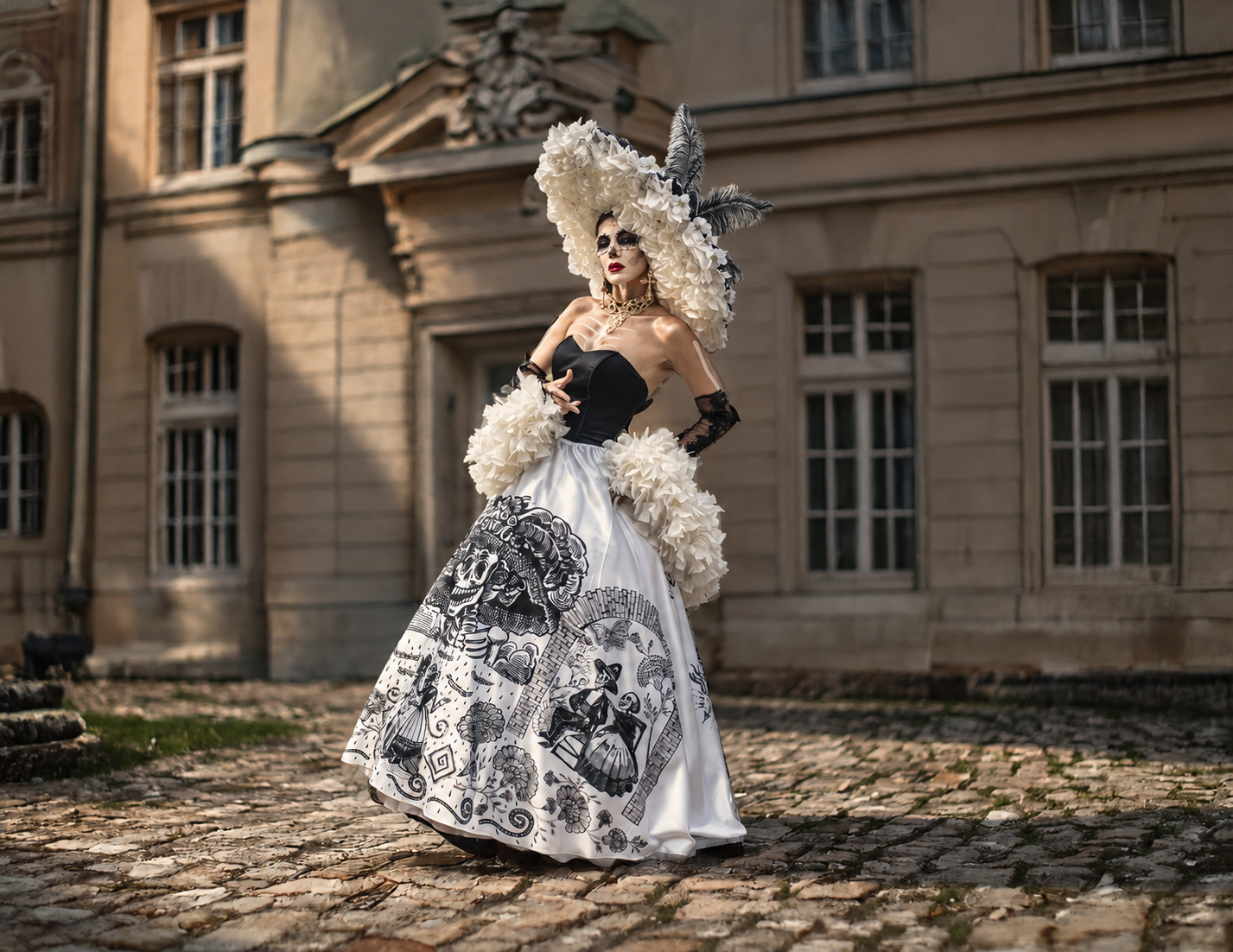
Catrina Posadas was created to honor the legacy of the first and most influential image in the history of Mexican cultural symbolism: La Calavera Garbancera, sketched by illustrator and engraver José Guadalupe Posada in the early twentieth century. Posada created the etching between 1910 and 1913, using satire to critique the social aspirations of the garbanceros, people who rejected their Indigenous identity in favor of appearing European. His skeletal figure, adorned only with an extravagant hat, became a bold artistic statement about class, identity, and the masks society wears.
Although Posada’s Garbancera was already powerful in its social message, it was decades later that the figure gained the name and full persona known today as La Catrina. In 1947, muralist Diego Rivera reimagined Posada’s character in his monumental fresco Sueño de una tarde dominical en la Alameda Central (Dream of a Sunday Afternoon in the Alameda Central). Rivera dressed the once-bare skull figure in a grand, elegant gown and placed her at the center of Mexico’s cultural history, standing hand in hand with a childlike version of himself, while Posada appears proudly at her side.
Through Rivera’s reinterpretation, Posada’s satirical skeleton became the elegant, towering Catrina—a symbol of life, death, identity, and the unbreakable connection between Mexico’s past and present. Rivera’s mural immortalized her, transforming a political cartoon into the national emblem of Día de Muertos recognized across the world.
Catrina Posadas honors this lineage by returning to the roots of what Posada created: a figure that reveals truth through artistry and invites reflection on who we are beneath appearances. Inspired by the raw satire of Posada and the iconic elegance introduced by Rivera, this Catrina bridges the early 1900s with today’s cultural renaissance, carrying forward a legacy that has shaped Mexican identity for more than a century.
Through her presence, Catrina Posadas stands as a tribute to both masters—Posada and Rivera—and to the enduring power of art to interpret heritage, critique society, and celebrate the beauty of remembrance.

CREDITS
Executive Producer: @ararom.producer
Film and Content Producer: @lotusocialmedia
Photography: @doc.shots_