Mictecacíhuatl, whose name is commonly translated as “Lady of the Dead,” was one of the principal deities associated with death and the Mexica underworld. She was the consort of Mictlantecuhtli, Lord of Mictlán, and together they ruled the deepest region of the underworld. INAH identifies them as the lord and lady of Mictlán and places them at the final stage of the journey of the dead.
For the Mexica, the destination of the dead depended largely on the manner of death rather than on moral judgment. Those who died ordinary deaths were generally believed to travel to Mictlán. Other destinations included Tlalocan for deaths associated with water or lightning, the solar realm for certain warriors and women who died in childbirth, and Chichihualcuauhco for infants.
The journey to Mictlán was described as a difficult passage through nine levels of the underworld. Early colonial sources differ somewhat in the names and order of these stages, but they consistently describe a sequence of dangerous obstacles that the dead had to overcome before reaching the final region governed by Mictlantecuhtli and Mictecacíhuatl. Sources associated with the Códice Vaticano A include places such as Apanohuayan, the passage through water; Tepetl Monanamicyan, where mountains collide; Itztépetl, the mountain of obsidian; Itzehecayan, the place of obsidian winds; Temiminaloyan, where the dead are struck by arrows; and Teyollocualoyan, where hearts are consumed. The ninth level was associated with Mictlán and its rulers.
The passage was traditionally understood to last four years. INAH records that after this long transit, the dead reached the ninth level, Chicunamictlán, where Mictlantecuhtli and Mictecacíhuatl received them. Archaeological and ethnohistorical studies also describe the four-year period as central to the Mexica understanding of the journey after an ordinary death.
Mictecacíhuatl also appears in traditions connected with ceremonies honoring the dead and ancestors. INAH notes that she and Mictlantecuhtli presided over festivities involving offerings of food, flowers, and dances, practices that form part of the pre-Hispanic background to later Mexican traditions surrounding the dead.
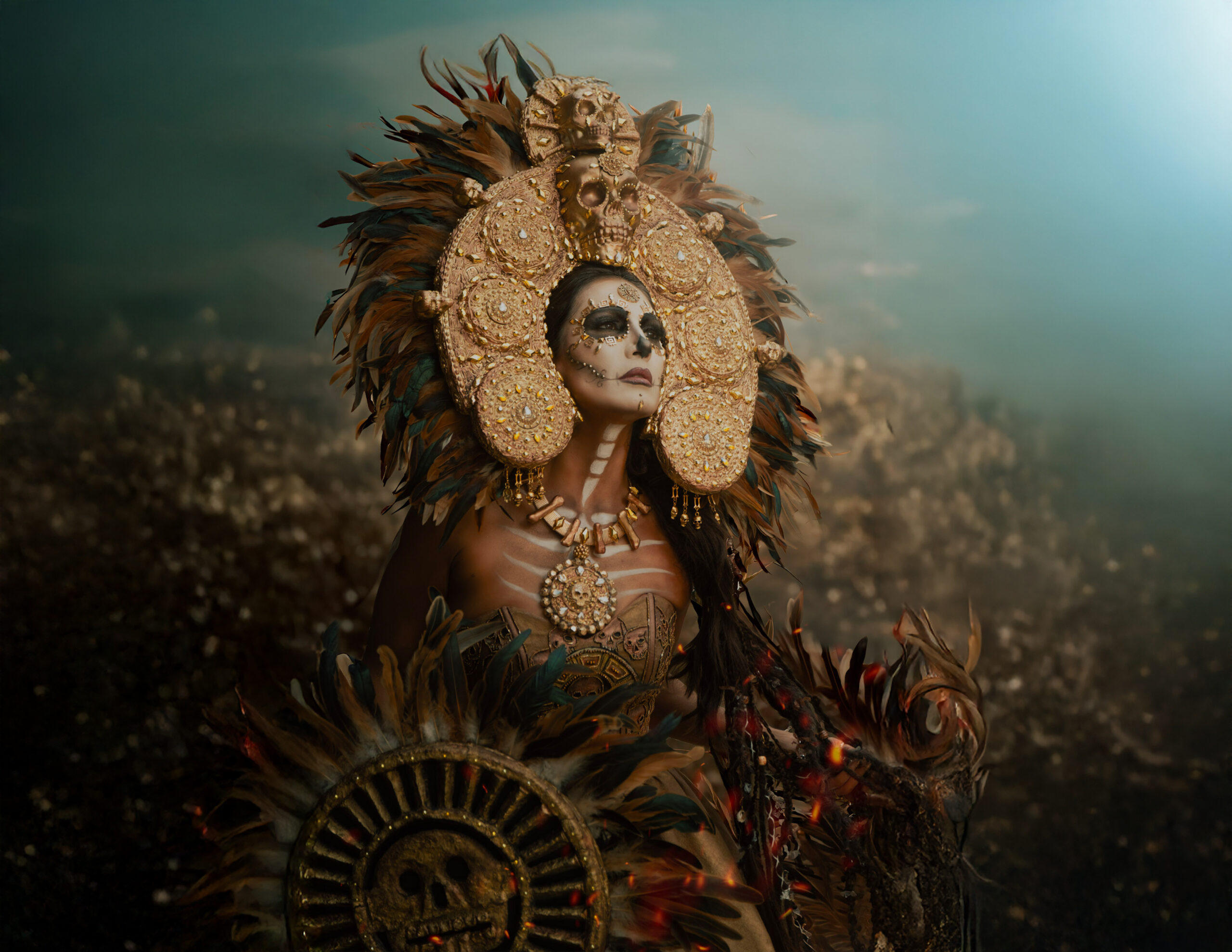
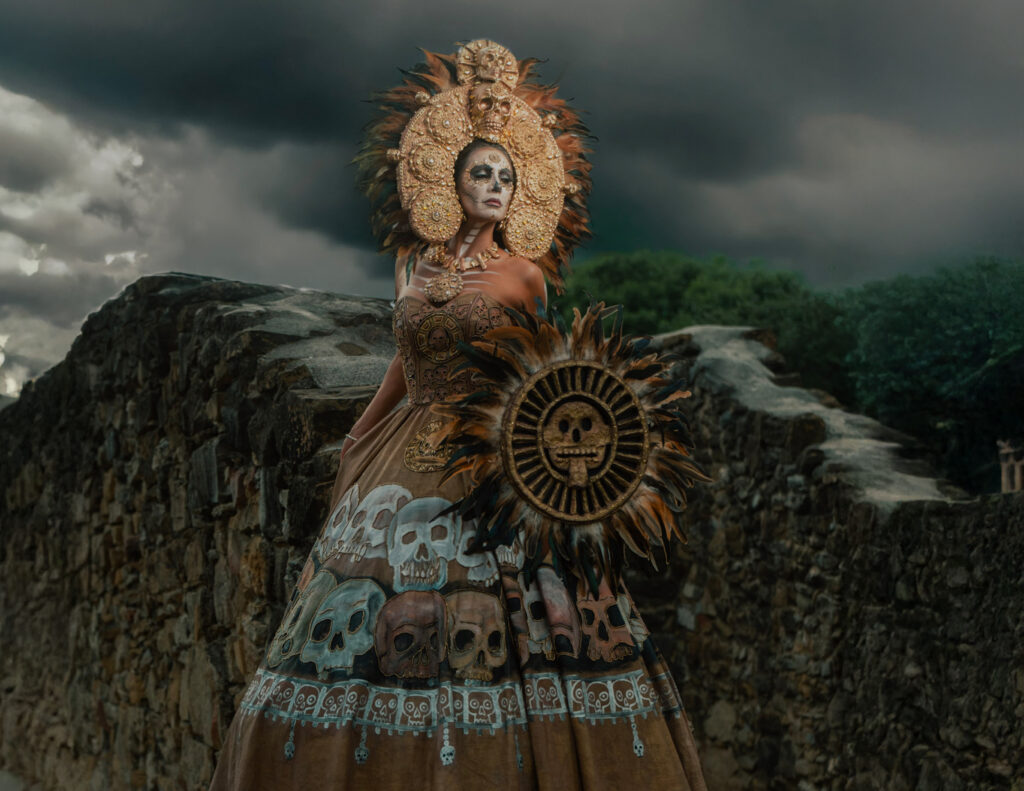
The iLaCatrina® interpretation of Mictecacíhuatl includes a replica inspired by the Disk of Death, an important stone sculpture in the collection of Mexico City’s Museo Nacional de Antropología. The original was discovered near the Pyramid of the Sun at Teotihuacán and depicts a skeletal face with the tongue extended, surrounded by a radiating element interpreted as folded paper. The sculpture has been associated with death and the deities of the underworld, and it has at times been identified with Mictlantecuhtli, although its precise meaning remains debated.
Within the Mexican Ancestral Collection, Mictecacíhuatl represents the Mexica conception of Mictlán, the four-year journey of the dead, the nine levels of the underworld, and the divine pair who governed the final destination of those who completed that passage.